 Admin
AdminManaging workforce attendance across multiple factories, warehouses, construction
sites, and operational locations has become increasingly complex for Indian
businesses.
Traditional attendance systems that once worked for single-location operations are now
struggling to keep up with modern workforce realities.
Today’s businesses operate with:
Distributed teams
Multiple shifts
Contract labour ecosystems
Mobile workforces
Remote project sites
Dynamic staffing requirements
In this environment, workforce visibility is no longer optional. It is operationally critical.
This is why businesses across manufacturing, logistics, infrastructure, facility
management, and warehousing are rapidly adopting Labour Attendance Apps to
simplify workforce tracking and improve operational control.
The Problem With Traditional Attendance Systems
Many businesses still rely on outdated attendance methods such as:
Manual registers
Spreadsheet tracking
Punch cards
Location-specific biometric devices
Contractor-maintained attendance sheets
While these systems may appear manageable initially, they create serious operational
limitations as businesses scale.
For organisations managing multiple locations, traditional systems often lead to:
Delayed attendance visibility
Attendance manipulation
Proxy punching
Payroll discrepancies
Overtime confusion
Lack of workforce transparency
Delayed approvals
Increased administrative dependency
The bigger the workforce becomes, the harder manual coordination gets.
Why Multi-Location Workforce Management Is More Challenging Today
India’s workforce ecosystem has evolved significantly.
Businesses now manage workers across:
Manufacturing plants
Warehouses
Retail outlets
Construction sites
Distribution hubs
Client locations
Temporary project sites
Many workers are mobile, shift-based, or contractor-managed.
In such environments, HR teams and plant managers often struggle to answer basic
operational questions in real time:
How many workers are currently active?
Which contractor has deployed manpower today?
Who is working overtime?
Which locations are understaffed?
Are attendance records genuine?
Are workers present at assigned sites?
Without centralized visibility, workforce management becomes reactive instead of
strategic.
The Shift Toward Mobile-First Workforce Management
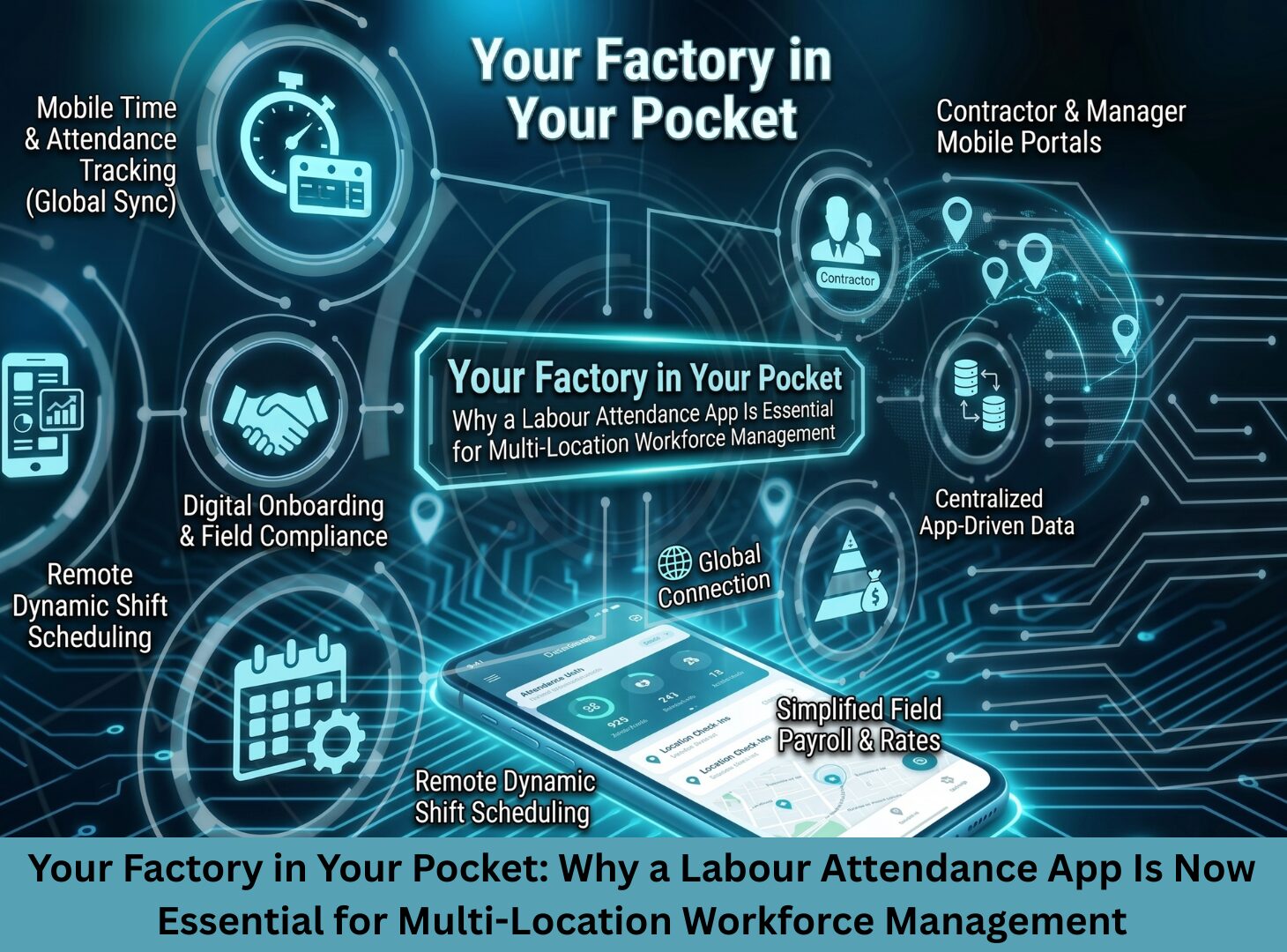
A Labour Attendance App transforms attendance from a static administrative task into a
real-time operational system.
Instead of depending on manual reporting from different sites, businesses gain instant
workforce visibility through a centralized mobile platform.
Attendance data becomes accessible in real time across locations, helping leadership
teams make faster and more informed decisions.
This is especially important for businesses managing:
Large contract labour teams
Field workforce operations
Rotational shifts
Remote project locations
High-volume manpower deployment
Key Features That Modern Businesses Now Expect
GPS and Geo-Fencing Attendance
One of the biggest concerns in workforce management is ensuring workers are actually
present at assigned locations.
GPS-enabled attendance systems help businesses verify location-based check-ins
while geo-fencing restricts attendance marking outside designated work zones.
This reduces:
Fake attendance entries
Off-site punching
Unauthorized check-ins
Attendance disputes
For multi-location businesses, this adds a critical layer of workforce authenticity.
Key Features That Modern Businesses Now Expect
GPS and Geo-Fencing Attendance
One of the biggest concerns in workforce management is ensuring workers are actually
present at assigned locations.
GPS-enabled attendance systems help businesses verify location-based check-ins
while geo-fencing restricts attendance marking outside designated work zones.
This reduces:
Fake attendance entries
Off-site punching
Unauthorized check-ins
Attendance disputes
For multi-location businesses, this adds a critical layer of workforce authenticity.
Selfie and Face Verification
Modern Labour Attendance Apps now include selfie-based and face verification
systems to minimize proxy attendance.
This improves workforce accountability while maintaining accurate attendance records
for payroll and compliance processes.
Offline Attendance Capability
Many industrial zones, warehouses, and remote sites experience unstable internet
connectivity.
Offline attendance functionality ensures attendance data can still be captured and
synced once connectivity is restored.
This prevents operational interruptions and ensures continuity across remote locations.
Real-Time Overtime Visibility
Overtime management becomes difficult when attendance records are delayed or
manually consolidated.
A centralized attendance platform provides real-time visibility into:
Overtime hours
Shift extensions
Attendance deviations
Workforce deployment patterns
This improves payroll accuracy while helping businesses manage labour costs more
effectively.
Simplified Leave and Approval Workflows
Manual leave approvals often create delays and communication gaps between workers,
supervisors, contractors, and HR teams.
Labour Attendance Apps simplify:
Leave requests
Supervisor approvals
Shift updates
Attendance corrections
Escalation workflows
This reduces administrative dependency while improving operational responsiveness.
Role-Based Access for Better Control
Different stakeholders within workforce operations require different levels of access.
Modern systems allow businesses to define role-based permissions for:
HR teams
Plant managers
Contractors
Supervisors
Compliance teams
•eadership stakeholders
This improves operational control while maintaining data security and process
accountability.
Integration With Payroll and Contractor Billing
Attendance systems are no longer standalone tools.
Today’s businesses require attendance data to integrate directly with:
Payroll systems
Contractor billing
Overtime calculations
Wage processing
Compliance reporting
Integrated workforce systems reduce duplication, improve accuracy, and simplify
workforce administration.
Why Businesses Are Prioritizing Workforce Visibility
In labour-intensive industries, delayed workforce information directly affects operations.
Real-time workforce visibility helps businesses:
Reduce absenteeism
Improve shift planning
Optimize manpower deployment
Minimize payroll disputes
Improve contractor accountability
Reduce administrative overhead
Strengthen compliance readiness
For leadership teams, workforce visibility is now directly linked to operational efficiency.
Data Security and Scalability Matter More Than Ever
As workforce operations become digitized, businesses are increasingly prioritizing:
Secure workforce data storage
Controlled system access
Centralized reporting
Multi-location scalability
Regional language accessibility
Low-end Android compatibility
A modern Labour Attendance App must not only simplify attendance management but
also adapt to large-scale industrial workforce environments.
How Emsphere Simplifies Workforce Attendance Management
Emsphere Technologies provides a Labour Attendance Management solution designed
for businesses managing complex workforce operations across multiple locations.
The platform enables organizations to track attendance in real time through mobile-
based systems with features such as GPS tracking, geo-fencing, face verification,
attendance automation, payroll integration, and centralized workforce visibility.
Designed for industrial and contract labour environments, the system helps businesses
simplify attendance operations while improving workforce transparency and operational
efficiency.
Conclusion
As workforce ecosystems become larger and more distributed, traditional attendance
systems are no longer sufficient for modern operational requirements.
Businesses today need real-time workforce visibility, location-based attendance
accuracy, integrated payroll workflows, and scalable attendance management systems.
A Labour Attendance App helps organisations move beyond manual workforce tracking
and build a more structured, transparent, and operationally efficient workforce
ecosystem.
For businesses managing multiple locations, the ability to monitor workforce operations
from anywhere is no longer a convenience.
It is becoming a necessity.